

Dry Skin Care:
HOW TO NOURISH AND PROTECT YOUR SKIN
Summary
Dry facial skin can result from reduced natural oils, environmental stress, and daily habits that affect the skin barrier. Identifying the underlying causes makes it easier to choose suitable care and maintain balance.
A consistent routine with gentle cleansing, targeted hydration, and daily protection can help maintain comfort, resilience, and avoid skin dryness over time. With thoughtfully formulated products designed for dry skin, NIVEA helps maintain softness, strengthen the skin barrier, and promote a healthy-looking complexion.
Dry facial skin is a common concern at any stage of life. It can feel tight, uncomfortable, or appear dull when its lipid barrier is compromised or it lacks moisture.¹ With the right daily care and carefully selected ingredients, dry skin can feel softer, smoother, and more balanced.²
This guide explores why dry facial skin develops, how it differs from dehydrated skin, and how a thoughtful skincare routine with targeted NIVEA products can restore hydration, reinforce the skin barrier, and maintain lasting softness.
Symptoms Of
DRY SKIN
Dry skin can show up in a variety of ways, and recognising the signs early makes it easier to care for your skin effectively.³ Common symptoms include:

• Tightness: Skin may feel taut, especially after cleansing or exposure to water.
• Rough or flaky texture: The surface of the skin can feel uneven, dry, or flaky.
• Dullness: Reduced natural oils can leave the complexion looking lacklustre or tired.
• Itchiness or irritation: Dry skin may feel itchy, sensitive, or be prone to redness.
• Fine lines: Lack of moisture can accentuate Fine lines and make the skin appear less smooth.
Being aware of these symptoms helps you choose gentle cleansing, targeted hydration, and protective skincare routines that restore softness and comfort.
7 Common Causes Of
Dry Skin ON THE FACE
Dry skin develops when the skin’s natural protective barrier does not retain enough moisture. This often happens when the production of natural oils, also known as sebum, is reduced or disrupted.⁴ While dry skin can affect anyone, it is usually influenced by a combination of environmental exposure, daily habits, and natural biological changes.
1. Environmental Factors
External conditions play a significant role in skin dryness. Cold temperatures, wind, and low humidity can draw moisture away from the skin, leaving it feeling tight or uncomfortable. Indoor heating and air conditioning may further reduce moisture levels in the air, which can weaken the skin barrier over time.⁵
Sun exposure can also impact the skin’s natural defences, as UV rays may compromise barrier function and contribute to moisture loss.⁶ Over time, this can make the skin feel tight, rough, or less resilient. Even frequent air travel, where cabin air is particularly dry, can leave facial skin feeling Dehydrated skin and less supple.

KEY FACTS ABOUT DRY FACIAL SKIN
Symptoms: Dry facial skin can appear tight, rough, or flaky, sometimes making the complexion appear dull or uneven. Alongside the face, dryness may also affect areas such as the elbows, legs (particularly the knees), and dry skin on elbows.
Causes: Low sebum production, exposure to harsh weather conditions, and indoor heating or air conditioning systems can cause dry skin by taking out the skin's moisture.
Treatment: Apply a moisturising Cream for dry skin to your face and body after cleansing, as this helps to replenish moisture and strengthen the skin's natural skin barrier.
Prevention: Maintaining a consistent skincare routine is vital to maintain hydration and improve the overall condition of the skin. Wear breathable clothing, Protect your skin from sunburn and humidify the air inside your home.
The Difference Between
DRY AND DEHYDRATED SKIN
While the terms are sometimes used interchangeably, dry skin and Dehydrated skin are not the same. Dry skin occurs when the skin lacks natural oils, which can leave it feeling tight, rough, or flaky. Dehydrated skin, on the other hand, is caused by a shortage of water in the outer layer of the skin. This means even skin that is oily skin in appearance can feel parched or uncomfortable at times.¹⁴
Recognising the difference is key to choosing the right care. Products enriched with nourishing ingredients such as ceramides, squalane, and hyaluronic acid help to support the skin’s lipid barrier function and hydration, supporting a balanced skin barrier.¹⁵ ¹⁶ With consistent care, facial skin can feel soft and hydrated, maintaining its natural suppleness throughout the day.
6 WAYS TO HELP AVOID
DRY SKIN ON THE FACE
Caring for dry facial skin is about gentle daily habits that help maintain hydration, comfort, and resilience.

Drinking enough water supports overall skin health and can help prevent dryness. Well-hydrated skin feels soft, comfortable, and retains its natural elasticity.¹⁷
SOLUTIONS FOR
DRY SKIN
Addressing dry skin effectively requires consistent care and targeted hydration. Simple changes to your daily skincare routine, such as using gentle cleansers, nourishing Serum, and moisturisers, can help restore comfort, maintain hydration, and keep skin soft, smooth, and healthy-looking. The following routines provide step-by-step guidance to support dry skin at every stage, whether you are focusing on general hydration or more intensive care for very dry areas.
Step-By-Step Skincare Routine For
DRY SKINA consistent, structured routine with products designed for dry skin can help maintain comfort and hydration. The following routines use carefully selected NIVEA products to support skin that feels soft, nourished, and healthy-looking.

Step 1: Cleanse
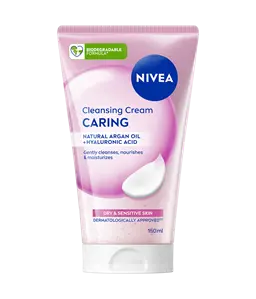
Gently cleansing the skin removes dirt, excess sebum, and impurities while maintaining its natural moisture balance. Using a mild, hydrating formula enriched with nourishing oils helps smooth and care for dry skin, leaving it soft, comfortable, and primed to absorb hydration effectively in the next steps.
Step 2: Serum
Serum contain concentrated active ingredients that target specific skin concerns such as wrinkles or dryness. Apply NIVEA Q10 Anti-Wrinkle Collagen Expert 3-in-1 Repairing Serum, which helps reduce the appearance of wrinkles and supports skin elasticity. Designed for mature skin and very dry and mature skin and dermatologically tested, it is enriched with NIVEA Q10, collagen Peptides, and ceramides to help leave the skin feeling smoother, firmer, and comfortably hydrated.
Daily sun protection helps defend the skin against UVA/UVB rays and visible light, which can contribute to premature skin ageing. Apply NIVEA UV Face Anti-Age Q10 Cream SPF 50 as the final step in your morning routine. Enriched with NIVEA Q10, it helps Protect and Moisturize the skin, supporting a smoother, more comfortable complexion. Its Lightweight formula is designed for Normal skin to dry skin and is suitable for everyday use.
Explore the full NIVEA Q10 range
Q10 Facial ButterMen's Skincare Routine For
DRY Facial SKIN
Morning Routine

Step 1: Cleanse
Start by removing overnight buildup while maintaining the skin’s natural balance. Use NIVEA MEN Sensitive Face Wash, a gentle, non-drying formula that removes impurities while providing fivefold protection against irritation, dryness, Redness, tightness, and itchiness.
Step 2: Shave & Soothe (Optional)
If shaving, follow cleansing with NIVEA MEN Sensitive Post Shave Balm, a gentle, alcohol-free Balm that soothes shaving rash and helps reduce Redness, dryness, and tightness after shaving, while helping to strengthen the skin barrier for lasting comfort.
Step 3: Moisturise & Protect
One of the most important steps in caring for dry skin is Moisturize and Protect it. Apply NIVEA MEN Sensitive Daily Protect Moisturiser SPF 30 to help keep skin hydrated and comfortable throughout the day while providing SPF30 protection and 3x protection against UVA/UVB rays, blue light effects, and pollution effects. The formula contains VitaminPRO Complex (vitamin e and Provitamin B5) and delivers an Immediate effect moisture boost with a Non-greasy, Lightweight, Fast-absorbing texture for daily comfort.
Evening Routine
Step 1: Cleanse
Cleanse your skin using NIVEA MEN Sensitive Face Wash to gently remove impurities while providing fivefold protection against irritation, dryness, Redness, tightness and itchy skin.
Step 2: Serum
Serums deliver concentrated ingredients that support Hydrate and help maintain a more resilient, comfortable complexion. Use NIVEA MEN Anti-Age Power 2 IN 1 Serum, a Fast-absorbing formula that may help reduce dark spots, age spots, and wrinkles while keeping your skin hydrated and feeling Revitalize.
Step 3: Eye Care
The delicate skin around your eyes is prone to puffy eyes, wrinkles and dry skin under eyes, so targeted care helps maintain softness and firmness. Use NIVEA MEN Hyaluron Anti-Age Eye Cream to reduce eye bags, firm the skin, and smooth eye wrinkles while keeping the area hydrated and comfortable.
Step 4: Moisturise
Finish with NIVEA MEN Sensitive Intensive Face Cream to provide Long-lasting moisture for up to 48 hours and all-day relief from 5 signs of irritation. It helps leave your skin feeling soothed, hydrated and comfortable overnight.
FAQs
FAQs
Related
Products






Sources:
1. Clinic, C. Dry Skin (Xeroderma): Symptoms, Causes, Treatment & Prevention. Cleveland Clinic.
https://my.clevelandclinic.org/health/diseases/16940-dry-skin
2. Kim, S.; Ly, B. K.; Ha, J. H.; Carson, K. A.; Hawkins, S.; Kang, S.; Chien, A. L. A Consistent Skin Care Regimen Leads to Objective and Subjective Improvements in Dry Human Skin: Investigator-Blinded Randomized Clinical Trial. Journal of Dermatological Treatment 2020, 33 (1), 1–22.
https://doi.org/10.1080/09546634.2020.1751037
3. Gade, A.; Matin, T.; Rubenstein, R. Xeroderma. PubMed.
https://www.ncbi.nlm.nih.gov/books/NBK565884/
4. Harvard Health Publishing. Dry Skin - Harvard Health. Harvard Health.
https://www.health.harvard.edu/a_to_z/dry-skin-a-to-z
5. Engebretsen, K. A.; Johansen, J. D.; Kezic, S.; Linneberg, A.; Thyssen, J. P. The Effect of Environmental Humidity and Temperature on Skin Barrier Function and Dermatitis. Journal of the European Academy of Dermatology and Venereology 2015, 30 (2), 223–249.
https://doi.org/10.1111/jdv.13301
6. Biniek, K.; Levi, K.; Dauskardt, R. H. Solar UV Radiation Reduces the Barrier Function of Human Skin. Proceedings of the National Academy of Sciences of the United States of America 2012, 109 (42), 17111–17116.
https://doi.org/10.1073/pnas.1206851109
7. Guéhenneux, S.; Gardinier, S.; Morizot, F.; Fur, I.; Tschachler, E. Skin Surface Hydration Decreases Rapidly during Long Distance Flights. Skin Research and Technology 2011, 18 (2), 238–240.
https://doi.org/10.1111/j.1600-0846.2011.00560.x
8. Dry Skin. Johns Hopkins Medicine.
https://www.hopkinsmedicine.org/health/conditions-and-diseases/dry-skin
9. Maarouf, M.; Maarouf, C. L.; Yosipovitch, G.; Shi, V. Impact of Stress on Epidermal Barrier Function. British Association of Dermatologists.
https://academic.oup.com/bjd/article-abstract/181/6/e157/6752206?redirectedFrom=fulltext&login=false
10. Luebberding, S.; Krueger, N.; Kerscher, M. Age-Related Changes in Skin Barrier Function - Quantitative Evaluation of 150 Female Subjects. International Journal of Cosmetic Science 2012, 35 (2), 183–190.
https://doi.org/10.1111/ics.12024
11. Evans, R. L.; Bates, S.; Marriott, R. E.; Arnold, D. S. The Impact of Different Hair-Removal Behaviours on the Biophysical and Biochemical Characteristics of Female Axillary Skin. International Journal of Cosmetic Science 2020, 42 (5), 436–443.
https://doi.org/10.1111/ics.12648
12. Cherney, K. What’s so Important About Skin pH? Healthline.
https://www.healthline.com/health/whats-so-important-about-skin-ph
13. Spada, F.; Barnes, T. M.; Greive, K. A. Skin Hydration Is Significantly Increased by a Cream Formulated to Mimic the Skin’s Own Natural Moisturizing Systems. Clinical, Cosmetic and Investigational Dermatology 2018, Volume 11, 491–497.
https://doi.org/10.2147/ccid.s177697
14. Debara, D. Dry vs. Dehydrated Skin: 8 Traits to Help You Tell the Difference. Healthline.
https://www.healthline.com/health/beauty-skin-care/dry-vs-dehydrated
15. Bravo, B.; Correia, P.; Gonçalves Junior, J. E.; Sant’Anna, B.; Kerob, D. Benefits of Topical Hyaluronic Acid for Skin Quality and Signs of Skin Aging: From Literature Review to Clinical Evidence. Dermatologic Therapy 2022, 35 (12).
https://doi.org/10.1111/dth.15903
16. Gao, P.; Xiao, X.; Zhou, Z.; Zhang, H.; Subramanian, R.; Sinsawat, A.; Gu, X. A Triple-Precursor Blend as a Topical Solution to Protect the Skin against Environmental Damage. Biology 2025, 14 (3), 266.
https://doi.org/10.3390/biology14030266
17. Rodrigues, L.; Palma, L.; Tavares Marques, L.; Bujan Varela, J. Dietary Water Affects Human Skin Hydration and Biomechanics. Clinical, Cosmetic and Investigational Dermatology 2015, 8 (8), 413.
https://doi.org/10.2147/ccid.s86822
18. Okuda, M.; Yoshiike, T.; Ogawa, H. Detergent-Induced Epidermal Barrier Dysfunction and Its Prevention. Journal of Dermatological Science 2002, 30 (3), 173–179.
https://doi.org/10.1016/s0923-1811(02)00106-8
19. Bernhardt, K. T.; Zaleski, E.; Li, W.-H.; Patel, R.; Parsa, R.; Miller, D.; Draelos, Z. D.; Bianchini, J. M. Skin Barrier Benefits of a Natural Moisturizing Factor and Lipids-Based Moisturizer for Clinically Sensitive Skin. Journal of Drugs in Dermatology: JDD 2025, 24 (10), 1029–1035.
https://doi.org/10.36849/JDD.9386
20. Moore, K. What Causes Dry Skin and How to Treat It. Healthline.
https://www.healthline.com/health/dry-skin#lifestyle-remedies